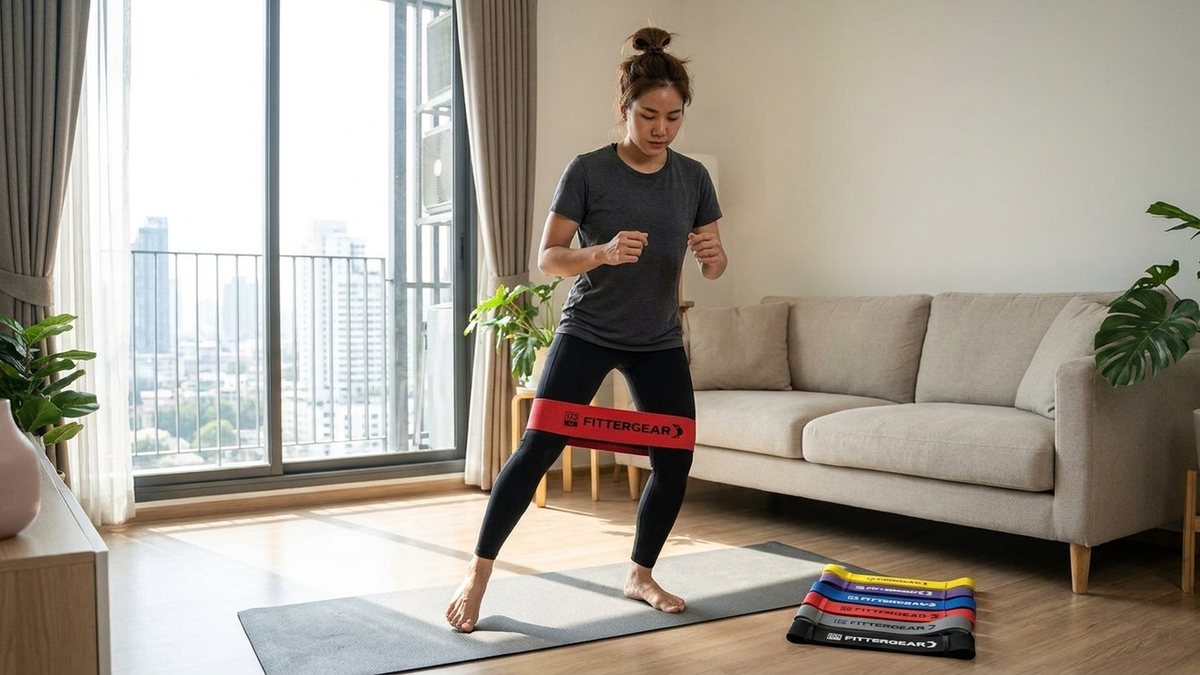
One set of resistance bands is enough for a full-body workout at home: legs, glutes, back, chest, shoulders, arms and core. Match the band type to the exercise, and pick a resistance where the last two or three reps feel hard but your form holds. Below are eight beginner-friendly exercises with step-by-step cues, a simple sets-and-reps plan and a guide to choosing resistance.
Three types of band, three jobs
- Mini bands (26 cm loops) go above the knees or ankles for glute and hip work, and for warm-ups.
- Long loop bands (Pro Bands) handle squats, rows, anchored core work and pull-up assistance at the gym.
- Tubes with handles (Power Tubes) feel like holding dumbbells, which suits curls, presses and chest work.
The 8-exercise resistance band workout
Beginners: 2–3 sets of 12–15 reps, 45–60 seconds rest, three non-consecutive days a week. Move slowly in both directions; never let the band snap back.
1. Band squat
- Stand on a long loop band, feet shoulder-width.
- Squat down and loop the top of the band behind you so it rests across your upper back, hands holding it at your shoulders.
- Stand tall, then sit back and down with knees tracking over toes.
Mistake: knees caving in, or the band riding up onto your neck.
2. Glute bridge
- Mini band above the knees, lie on your back, knees bent, feet a hand's length from your glutes.
- Push knees out against the band and drive through your heels until hips and thighs form a straight line.
- Squeeze for 1–2 seconds, lower slowly.
Mistake: over-arching so you feel it in the lower back rather than the glutes.
3. Lateral band walk
- Mini band above the ankles or knees, feet hip-width, slight knee bend.
- Step sideways with one foot, follow with the other, keeping tension on the band.
- Take 10–12 steps, then go back the other way.
Mistake: rocking the torso side to side, or standing too upright.
4. Seated row
- Sit with legs straight and loop a long band or tube around your feet.
- Sit tall holding both ends, arms extended.
- Pull elbows back past your ribs, squeeze the shoulder blades, return slowly.
Mistake: leaning back to cheat the rep and shrugging.
5. Chest press
- Wrap a tube behind your back just below the shoulder blades, handles beside your chest.
- Take a split stance and brace your core.
- Press forward until your arms are nearly straight, return under control.
Mistake: bent-back wrists, or the tube sliding up toward the neck.
6. Overhead press
- Stand on the middle of a tube, feet hip-width.
- Bring the handles to shoulder height, palms forward.
- Press overhead without flaring your ribs, then lower slowly.
Mistake: arching the lower back. If you need to, drop a level.
7. Biceps curl
- Stand on the tube, arms by your sides, palms forward.
- Keep elbows pinned and curl the handles to shoulder height.
- Lower more slowly than you lifted.
Mistake: swinging the body and letting elbows drift forward.
8. Pallof press
- Anchor a long band at chest height to a solid post or rail and stand side-on to it.
- Hold the band at your sternum and step away until it is taut.
- Press straight out, resist the twist for two seconds, bring it back. Switch sides.
Mistake: letting hips and shoulders rotate toward the anchor. The goal is resisting rotation.
How to choose the right resistance
If you can do more than 20 easy reps, move up a level. If you cannot reach 8 clean reps, move down.
- Mini Bands (glutes, hips): start with yellow (about 4.5 kg), progress to purple or green.
- Power Tubes (arms, shoulders): pink (10 lb) or green (20 lb) for curls and overhead presses; rows and chest presses usually take one level more.
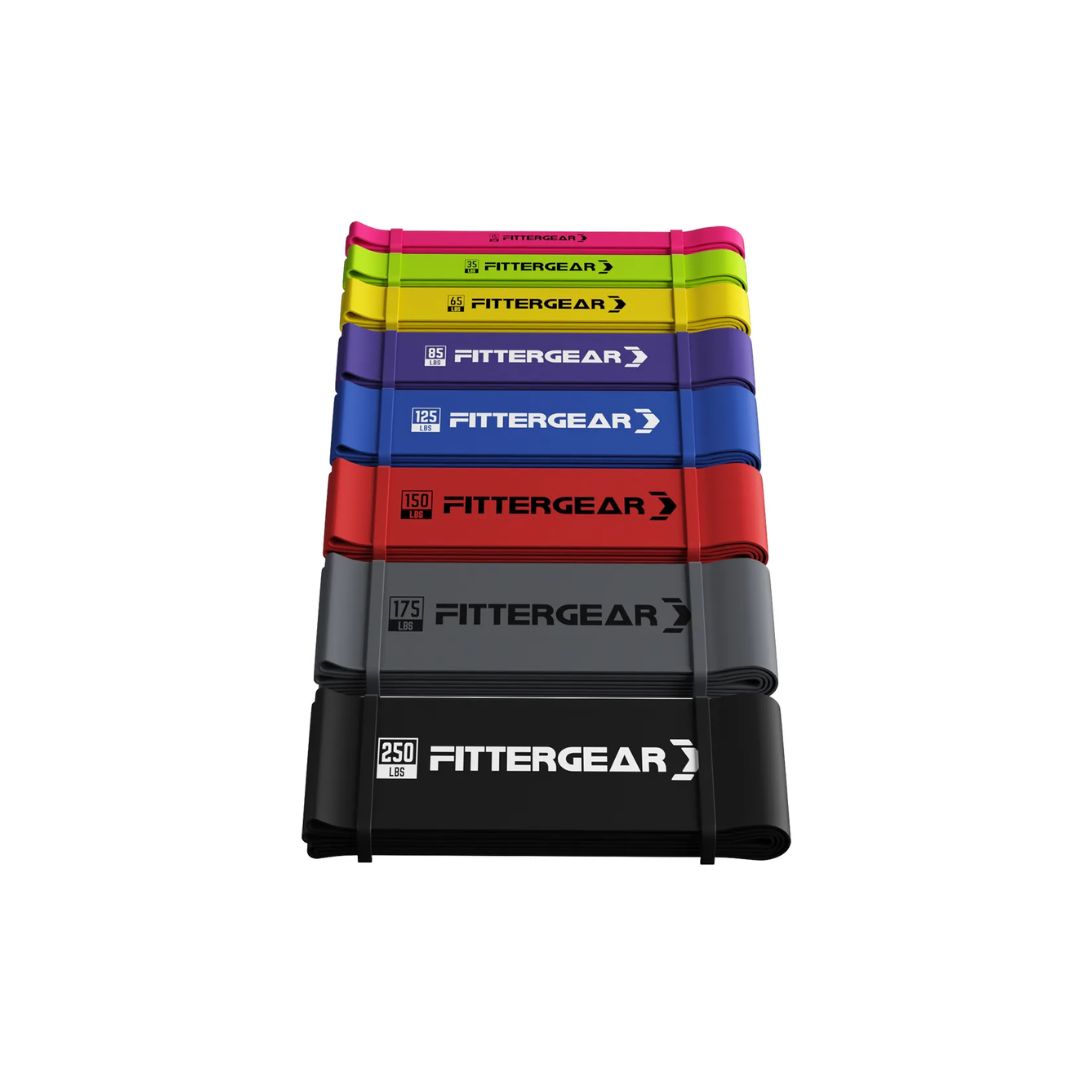
- Pro Bands (squats, Pallof press): pink (15 lb) or green (35 lb) to start. Yellow and heavier suit pull-up assistance and adding resistance to big lifts.
Ratings are approximate; tension rises the further you stretch the band. To make a band harder without switching, stand further from the anchor or shorten your grip.
Mistakes that stall progress
- Staying on the same light band for months.
- Letting the band snap back instead of controlling the return.
- Skipping a pre-workout check for nicks or thin spots; replace damaged bands.
- Anchoring to door handles or furniture that can move.
- Storing bands in direct sun or near sharp objects.
Which Fittergear band to buy
| Model | Resistance range | Best for |
|---|---|---|
| Fittergear Pro Bands | 8 levels, approx. 15–250 lb, natural latex | Squats, Pallof press, rows, pull-up assistance |
| Fittergear Mini Bands | 5 levels, approx. 10–50 lb, 26 cm loop | Glute bridges, band walks, warm-ups, yoga, Pilates |
| Fittergear Power Tubes | 6 levels, approx. 10–60 lb, with handles | Curls, chest press, overhead press |
For all eight exercises, pair Mini Bands for the lower body with one Power Tube level for the upper body. If you also lift at a gym, Pro Bands carry over to pull-up assistance and banded squats or bench presses. All of them pack into a gym bag.
FAQ
Are yoga bands and resistance bands the same thing?
Often, yes. Mini bands work in yoga and Pilates classes and for glute training; long loops and tubes are better for strength work.
Can I train with bands every day?
Light warm-up work, yes. For hard sessions, rest each muscle group at least a day. Three sessions a week is a good start.
Can bands really build strength?
Yes, if you train consistently and keep moving up in resistance. Visible change also depends on food, sleep and consistency.