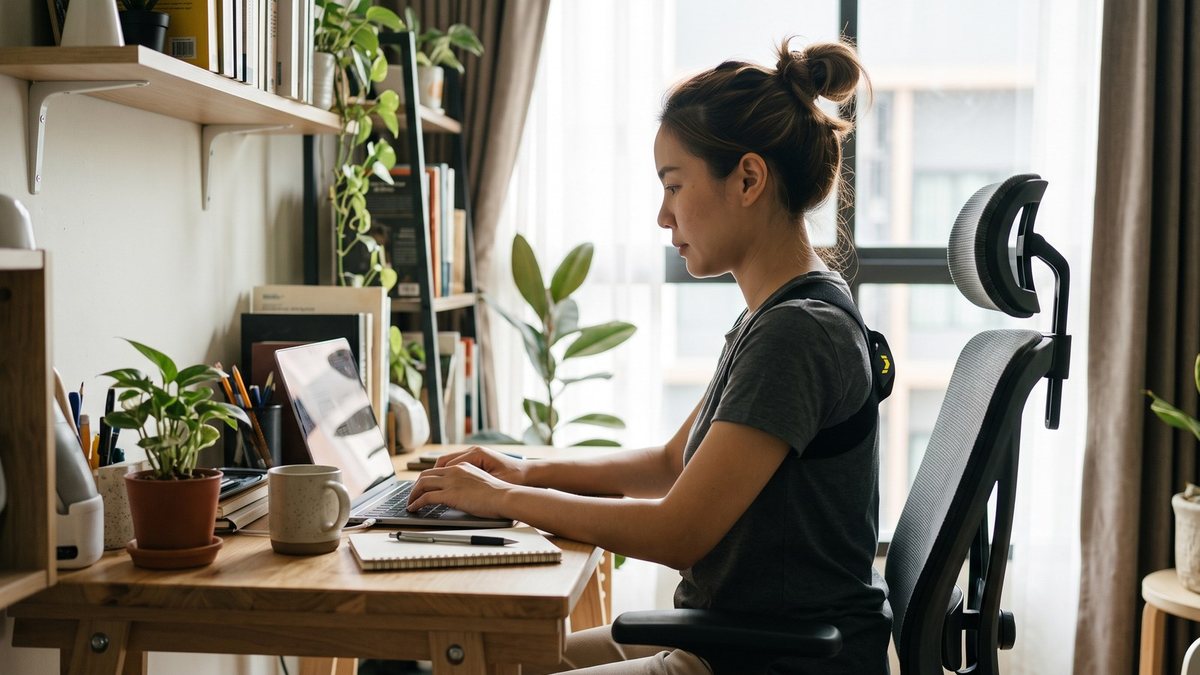
To wear a posture corrector, put it on like a backpack with the cross of the straps between your shoulder blades, then tighten it just enough that your shoulders are drawn gently back. It should feel like a reminder, not a clamp. Start with short sessions and train your upper back alongside it: the strap prompts you, but your own muscles hold the position once it comes off.
What a posture corrector does, and what it does not
After hours at a laptop, most of us drift into rounded shoulders without noticing. A posture corrector draws the shoulders back and opens the chest. When you start to slump, the straps tighten slightly, which is your cue to sit up.
- It gives support and a physical reminder of where your shoulders should be.
- It does not make your upper-back muscles stronger on its own.
How to put on a posture corrector
- Get the size right. Some models are sized by body weight. See the table below, or ask us on LINE @welstore.
- Loosen everything first so it goes on easily.
- Slip your arms through like a backpack. The loops sit at the front of your shoulders and the X crosses between your shoulder blades, not at your waist.
- Stand tall and relaxed. Draw your shoulders back and down, as if tucking your shoulder blades into your back pockets. No arching, no shrugging.
- Snug the straps in that position, without forcing your shoulders further back than you can hold yourself.
- Check the fit. You should breathe deeply and lift your arms with no rubbing under the armpits and no numbness in your arms or hands. If anything digs in, readjust.
How long should you wear it each day?
For the Posture Corrector for Women, the product information recommends 2 hours a day. The other two models do not state a wear time, so build up gradually:
- Week one: 15-30 minutes at a time, once or twice a day.
- Once it feels familiar: add time in small steps rather than jumping to all-day wear.
- Take breaks: remove it at lunch and walk or do the exercises below.
Starting short lets your body and skin get used to the straps, and keeps the strap a reminder rather than something holding your shoulders all day. Desk workers can wear it mid-afternoon, when slumping peaks; gym-goers can wear it for an upper-back warm-up, then take it off for heavy sets.
Four upper-back exercises to pair with it
This is the part that matters most. These moves train the muscles that pull your shoulder blades back, and most need just one band. The Fittergear Pro Bands come in 8 resistance levels; the lightest (pink, about 15 lb) is a good place to start.
1. Band pull-apart
- Hold the band at shoulder width, arms straight at chest height.
- Squeeze your shoulder blades together and pull the band apart until it nearly touches your chest.
- Pause, then return slowly without letting it snap back.
- 2-3 sets of 12-15 reps.
Keep your shoulders down. If you cannot reach full range, widen your grip or use a lighter band.
2. Face pull
- Anchor the band at forehead height and hold both ends, palms down.
- Step back to light tension, stand tall and brace your abs.
- Pull towards your face, elbows high and wide at shoulder level.
- Finish with your hands beside your ears, like a double-biceps pose, and hold a second.
- Return slowly. 2-3 sets of 12-15 reps.
3. Row
- Sit with legs straight, band looped around your feet, back tall.
- Draw your shoulder blades back first, then pull the band to your stomach, elbows close to your sides.
- Pause and feel the squeeze between your shoulder blades.
- Return slowly. 3 sets of 10-12 reps.
4. Wall angel
- Stand with your glutes, upper back and head against a wall, feet a foot-length away.
- Raise your arms into a W, elbows bent about 90 degrees, backs of the arms against the wall.
- Slide your arms overhead as far as you can while keeping contact, then back to the W.
- 2 sets of 8-10 reps.
Do not arch your lower back to reach the wall.
Putting it together: desk workers can do pull-aparts and wall angels during breaks once or twice a day. Gym-goers can add face pulls and rows to upper-body days 2-3 times a week and use pull-aparts as a bench press warm-up.
Common mistakes
- Too tight. Straps that dig into your armpits, limit breathing or numb your arms are overdone.
- All day from day one. Skin chafes, it feels uncomfortable, and people give up. Build up gradually.
- Relying on the strap alone. Without upper-back training and regular movement, old habits return when it comes off.
- Wrong position. Keep the cross between your shoulder blades, not down at your waist.
If you have back, neck or shoulder pain, or numbness down your arm, a strap is not the answer. Rest and see a doctor or physiotherapist.
Which posture corrector should you choose?
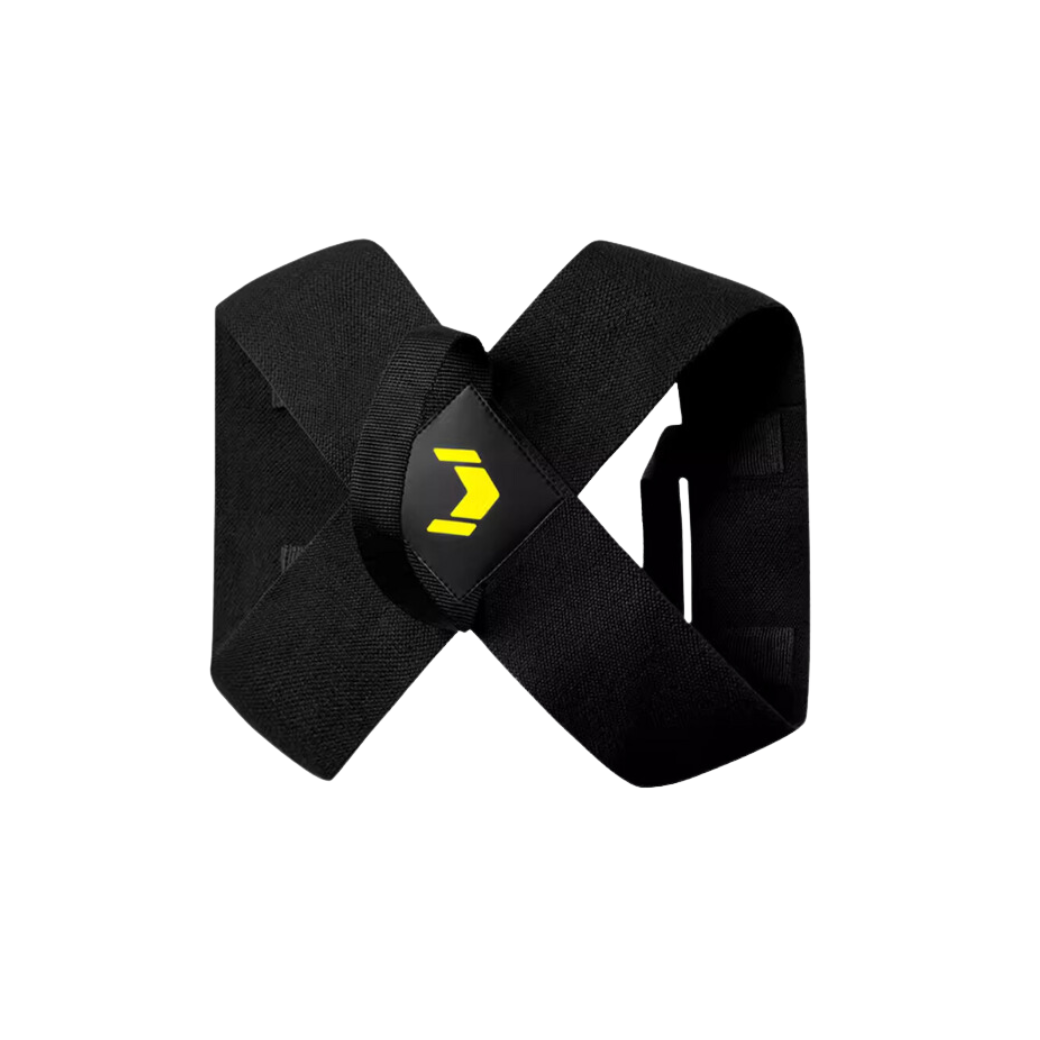
| Model | Material and sizes | Best for |
|---|---|---|
| Posture Corrector 2 | Cotton blend (60% cotton); S, M, L, XL | Desk workers wanting upper-back and shoulder support for daily wear |
| Posture Corrector Light Grey | 60% cotton, 40% latex; S (50-60 kg) to XL (85-100 kg) | Gym-goers who also want it for bench press, back pulls and shoulder press |
| Posture Corrector for Women | Soft stretchy X-strap, Cherry Blossom Pink; S (under 60 kg), M (60-70 kg), L (over 70 kg) | Women wanting a comfortable strap for yoga, exercise and workdays |
The Fittergear Posture Corrector 2 is freely adjustable and breathable, the straightforward pick for office days. For the gym as well, the Light Grey model has elastic, non-restrictive straps and is listed for a range of training. The women’s model has wider shoulder straps that do not dig in and a back buckle you can fasten without help.
FAQ
Can I sleep in a posture corrector?
We do not recommend it. Wear it while sitting or standing, and take it off at night.
How long until I no longer need it?
It depends on how consistently you train and move. When you notice yourself pulling your shoulders back without the strap more often, start cutting back the wear time.
Can I wear it while lifting?
For some movements. The Light Grey model is listed for bench press, back pulls and shoulder press. It does not replace a lifting belt for squats or deadlifts.